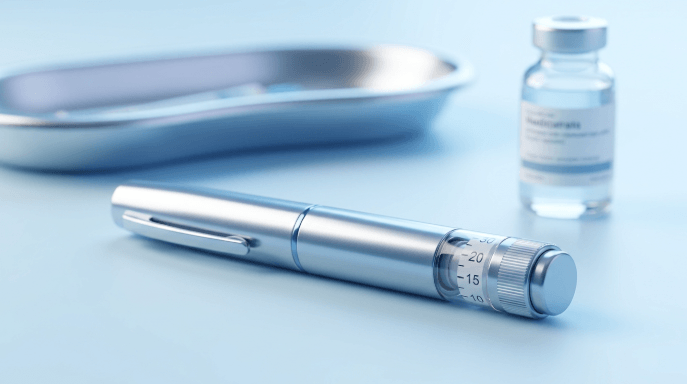
A responsible read on this compounded peptide resource starts with mechanism, side effects, access, and monitoring rather than promises. That frame keeps the discussion useful for patients without pretending the evidence is stronger than it is.
Last October, a 46-year-old ultrarunner I’ll call Dave sent me a lab panel and a photo of a peptide vial on his kitchen counter. He’d been dealing with chronic Achilles tendinopathy for two seasons, had worked through eccentric loading protocols, shockwave therapy, PRP, the whole catalog. A training buddy told him about AOD-9604. He’d already ordered it from a compounding pharmacy before he asked me what I thought. That order of operations is common. And it’s the wrong way around.
AOD-9604 is a research-stage peptide. It is not FDA-approved for any human indication. It was developed at Monash University as a synthetic fragment (amino acids 176-191) of the C-terminal region of human growth hormone, specifically isolated for its lipolytic properties. Metabolic Pharmaceuticals took it through phase 2 obesity trials, and it did not advance to approval. That history matters, because every conversation about this peptide has to start with an honest acknowledgment: we’re working with limited human data and a mechanism that’s biologically interesting but clinically unproven.
For masters-level endurance athletes stacking enormous connective tissue loads week after week, the appeal is obvious. The question is whether the appeal is justified.
The Mechanism, Without the Hype
The proposed mechanism of AOD-9604 is that it stimulates lipolysis and inhibits lipogenesis in adipose tissue, without triggering the IGF-1 elevation or glucose metabolism changes you’d see with intact growth hormone. Think of it as trying to borrow one page from a textbook without carrying the rest of the chapter.
That selective profile is genuinely interesting. It’s also why people in the endurance world get excited: the idea of a GH-fragment peptide that supports recovery and body composition without the metabolic baggage of full GH signaling. But mechanism plausibility is not clinical proof. Lots of compounds have elegant receptor stories and produce small or inconsistent results in actual humans. AOD-9604, as of 2026, sits squarely in that category.
What the Published Research Tells Us (and Doesn’t)
The evidence base clinicians most often reference:
- Ng and Bornstein (1978) did the early mapping of the lipolytic domain of GH that eventually became the foundation for the AOD fragment.
- *Heffernan et al. (2001, Endocrinology)* demonstrated lipolytic effects of the 176-191 fragment in animal models, critically without GH-like effects on glucose metabolism.
- Metabolic Pharmaceuticals phase 2 obesity trials (publicly summarized results) showed modest fat mass reductions but, again, did not lead to regulatory approval.
A careful reading: human evidence for body composition effects in non-obese adults is limited. The effects observed in published trials were modest. There are no large-scale randomized controlled trials in athletic populations, no published data specifically on connective tissue repair in endurance athletes, and nothing close to the evidence base behind, say, structured eccentric loading for tendinopathy.
If you’re going to try this peptide, you should be able to name the one or two studies most relevant to your use case and articulate where the evidence stops. If you can’t do that, you’re guessing. And compounded peptides aren’t cheap enough to guess with.
What a Structured Trial Actually Looks Like
The boring truth about compounded peptide protocols is that the protocol matters more than the peptide. The typical AOD-9604 compounded dosing is 250 to 500 mcg subcutaneous, once daily, usually in the morning before training. Trial length runs 8 to 12 weeks, and the mistake most people make is evaluating results by scale weight alone.
A well-designed trial has five pieces:
- Baseline labs appropriate to the indication. For anything touching the GH axis, that means IGF-1 and a metabolic panel at minimum.
- A defined trial window (8 to 12 weeks) with objective markers agreed upon in advance: photographic documentation, circumferential measurements, relevant pain scores, sleep data if applicable. You and your prescriber decide before the trial begins what signal would justify continuation.
- Patient-specific compounded dispense from a licensed 503A pharmacy, with the prescription, lot number, and beyond-use date on the label.
- A midpoint check-in to review tolerability and flag anything new.
- End-of-trial reassessment with a genuine decision point. Continuation should not be the default. If you’re not seeing measurable improvement against agreed benchmarks, you stop.
That structure is non-negotiable. Compounded peptides are not for open-ended, indefinite use without reassessment.
Side Effects and What Should Prompt a Phone Call
AOD-9604 generally has a milder side effect profile than GH secretagogues like ipamorelin or tesamorelin. Commonly reported effects include mild injection-site reactions and occasional GI upset. Most people tolerate it well.
The list that should trigger a call to your prescriber (not a “wait and see” approach): any symptom that doesn’t match the expected tolerability profile, any sign of allergic reaction, persistent worsening of whatever brought you to the peptide in the first place, and any lab value that drifts outside the range you and your clinician agreed to monitor.
Where AOD-9604 Fits in the Landscape
Here’s my genuinely opinionated take: AOD-9604 is being asked to do too many things by too many people who haven’t exhausted stronger options first.
If your primary goal is fat loss, GLP-1 receptor agonists produce dramatically larger effects through entirely different mechanisms. If your interest is GH-axis signaling for recovery, ipamorelin and tesamorelin operate through GH secretion with different (and better-characterized) downstream consequences.
For masters-level endurance athletes dealing with tendon and connective tissue overload, AOD-9604 should sit downstream of, not instead of, structured periodization, adequate caloric availability, and progressive eccentric loading. It’s like adding a turbocharger to a car with bald tires. The fundamentals come first.
The athletes I’ve seen get the most out of a peptide trial are the ones who already have their training load, nutrition, and sleep dialed in and are looking for a marginal addition, not a rescue mission.
Cost, Access, and the Prescriber Workflow
Through a licensed 503A compounding pharmacy, AOD-9604 typically runs $120 to $280 per month at standard doses. Telehealth prescriber visits are billed separately, usually $100 to $300 for an initial consult with follow-ups in a similar range. Insurance does not generally cover compounded peptide therapy for off-label or research-stage indications.
The patient-facing workflow through most telehealth practices in 2026: intake form, optional baseline labs, video prescriber visit, e-prescription to a partnered 503A pharmacy, shipped medication with instructions, and a follow-up visit at the end of the trial window. For readers who want a detailed version of this workflow laid out step by step, this compounded peptide resource walks through prescriber intake, baseline lab work, typical dose ranges, and the reassessment timeline used in clinical practice.
Frequently Asked Questions
Is AOD-9604 FDA-approved?
No. AOD-9604 is research-stage and not FDA-approved for any human indication. Metabolic Pharmaceuticals evaluated it for obesity and it did not advance to approval. It’s available through the compounded prescription pathway because licensed 503A pharmacies can prepare patient-specific medications on a prescriber’s order, even when no FDA-approved commercial product exists for that formulation.
How long does a typical AOD-9604 trial last before reassessment?
Most clinical protocols run 8 to 12 weeks. Reassessment should pair subjective symptom reporting with objective measures: body composition data, circumferential measurements, relevant lab values, pain scores, or sleep metrics depending on the indication.
What does AOD-9604 cost in compounded form?
Roughly $120 to $280 per month at typical compounded doses through a licensed 503A pharmacy. Telehealth prescriber fees are separate, typically $100 to $300 for an initial visit with follow-ups in a similar range.
What are the common side effects of AOD-9604?
Mild injection-site reactions and occasional GI upset are the most commonly reported. The side effect profile is generally milder than GH secretagogues. Patients with relevant medical history should review the full profile with their prescribing clinician before starting.
Can AOD-9604 be combined with other peptides or medications?
Combination protocols exist but should be designed by the prescribing clinician, not assembled from forum posts. GLP-1 agonists work through entirely different pathways and produce much larger weight loss effects. Ipamorelin and tesamorelin work through GH signaling with different downstream consequences. Stacking decisions require clinical oversight.
Who should not use AOD-9604?
Patients with pregnancy, active malignancy, severe hepatic or renal disease, or undiagnosed weight loss should not start a trial without specialist evaluation and clear documentation of the risk-benefit analysis. Compounded peptides are not a substitute for evidence-based treatment of active disease.
Should I talk to my clinician before starting?
Yes, and that relationship should already exist before you order anything. Dave (remember him from the top?) ended up having a productive conversation with a sports medicine physician who structured a proper 10-week trial with clear endpoints. That’s how this should work. Peptide first, clinician second is backwards.
Not FDA-approved. Compounded peptides are prepared by licensed 503A pharmacies for individual patients based on a prescriber’s clinical judgment. Individual results vary. This content is educational and does not replace evaluation by a qualified clinician.